
Aethermotics
Einbos
Over its nearly five year span, the project produced a substantial body of design work; including modular hard to soft prototypes, refined thermal systems, scalable production methods, fabrication techniques, per-production garments and hardware, as well as garment integration methods tailored for industrial and clinical use.
While the venture is no longer progressing in a commercial capacity, the design foundations remain strong. Much of the system architecture and integration strategy has relevance beyond its original context, and many elements of the work continue to influence how I approach wearable product design today.
Over its nearly five year span, the project produced a substantial body of design work; including modular hard to soft prototypes, refined thermal systems, scalable production methods, fabrication techniques, per-production garments and hardware, as well as garment integration methods tailored for industrial and clinical use.
While the venture is no longer progressing in a commercial capacity, the design foundations remain strong. Much of the system architecture and integration strategy has relevance beyond its original context, and many elements of the work continue to influence how I approach wearable product design today.
Project Overview
Aethermotics was a multi-year startup venture focused on developing low-layer wearable cooling systems for industrial and clinical environments. The project began as an exploration of discreet thermal regulation for motorcycle riders, but evolved as broader applications emerged across high-heat contexts such as healthcare, construction, and heavy industry.
As a co-founder and technical lead, I was invloved in the full lifecycle of the project, leading product design while working closely with engineering, manufactures and early users.
The work spanned concept development, prototyping, system architecture, garment development and integration, and preparation for manufacturing, alongside business development, fund raising/grants and ongoing market engagement that shaped key pivots and design decisions throughout the project’s evolution.
Over its nearly five year span, the project produced a substantial body of design work; including modular hard to soft prototypes, refined thermal systems, scalable production methods, fabrication techniques, per-production garments and hardware, as well as garment integration methods tailored for industrial and clinical use.
While the venture is no longer progressing in a commercial capacity, the design foundations remain strong. Much of the system architecture and integration strategy has relevance beyond its original context, and many elements of the work continue to influence how I approach wearable product design today.


Motorcycle Cooling Concept
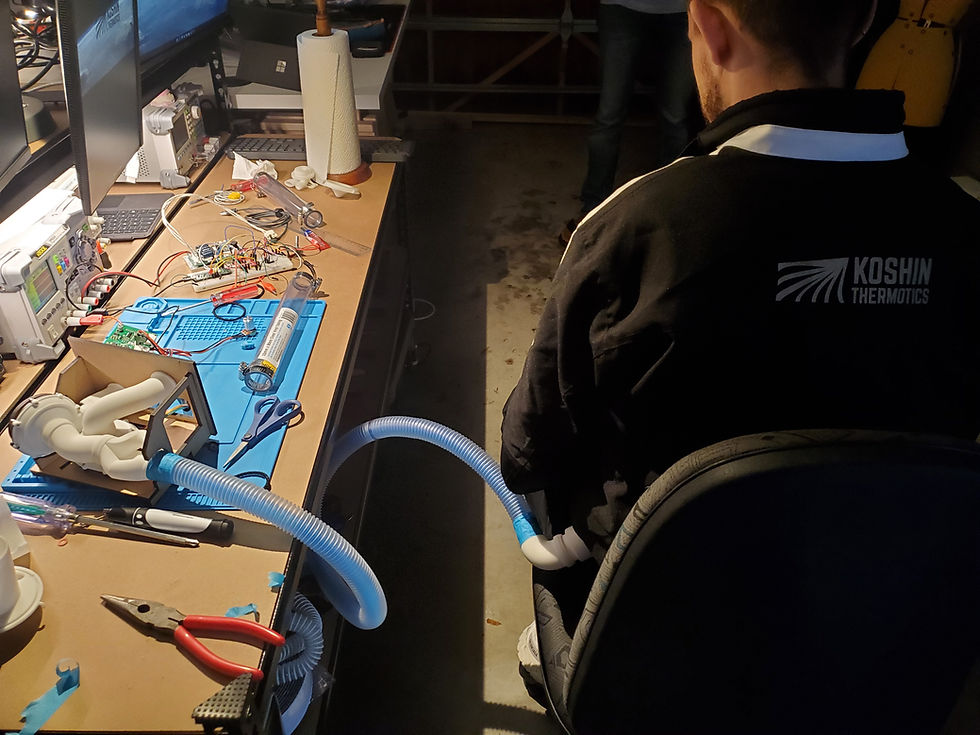
Aethermotics began as a design response to the intense heat, cold and discomfort experienced during long-distance motorcycle rides. The initial concept focused on delivering adaptive cooling or heating through a tethered, low-profile garment supplied by a miniature AC-style unit mounted on and powered by the bike. The garment had to be slim, silent, mobile and comfortable under tight gear, which meant developing new approaches to airflow delivery and garment construction.
This early phase involved deep research into on-body cooling systems, existing products, and the physiological dynamics of thermal relief. Dozens of competing products and research papers were reviewed, identifying a clear opportunity to explore adaptive cooling that preserved wearer mobility and didn’t rely on bulky ice vests, water loops or rigid enclosures.
Though the scope was narrow, this version established the groundwork for what would become a much broader and more ambitious system.


Motorcycle Cooling Concept
Aethermotics began as a design response to the intense heat, cold and discomfort experienced during long-distance motorcycle rides. The initial concept focused on delivering adaptive cooling or heating through a tethered, low-profile garment supplied by a miniature AC-style unit mounted on and powered by the bike. The garment had to be slim, silent, mobile and comfortable under tight gear, which meant developing new approaches to airflow delivery and garment construction.
This early phase involved deep research into on-body cooling systems, existing products, and the physiological dynamics of thermal relief. Dozens of competing products and research papers were reviewed, identifying a clear opportunity to explore adaptive cooling that preserved wearer mobility and didn’t rely on bulky ice vests, water loops or rigid enclosures.
Though the scope was narrow, this version established the groundwork for what would become a much broader and more ambitious system.


Outcomes
Aethermotics demonstrated that meaningful thermal relief in high-heat environments requires an integrated, system-level approach rather than isolated product interventions. Across multiple iterations, the work clarified how garment architecture, airflow management, hardware placement, and human factors must be developed together to achieve comfort, wearability, and durability.
The project produced a robust body of design work, including modular hard–soft integration methods, scalable garment strategies, and manufacturing-ready system architectures. While the venture ultimately closed due to external funding and resourcing constraints, the technical and design foundations remain intact. The outcomes continue to inform my approach to wearable product design, particularly in navigating complexity, constraint, and real-world use.